
Scenario in context
In this moment, the core challenge is to contain an active cyber intrusion without collapsing trading operations, undermining public confidence, or creating avoidable legal and regulatory exposure. The strongest options are those that preserve operational continuity while still responding dynamically to evolving attacker behavior.
›
Evaluation Criteria & Weightings
What mattered most in judging the Silent Trader option set
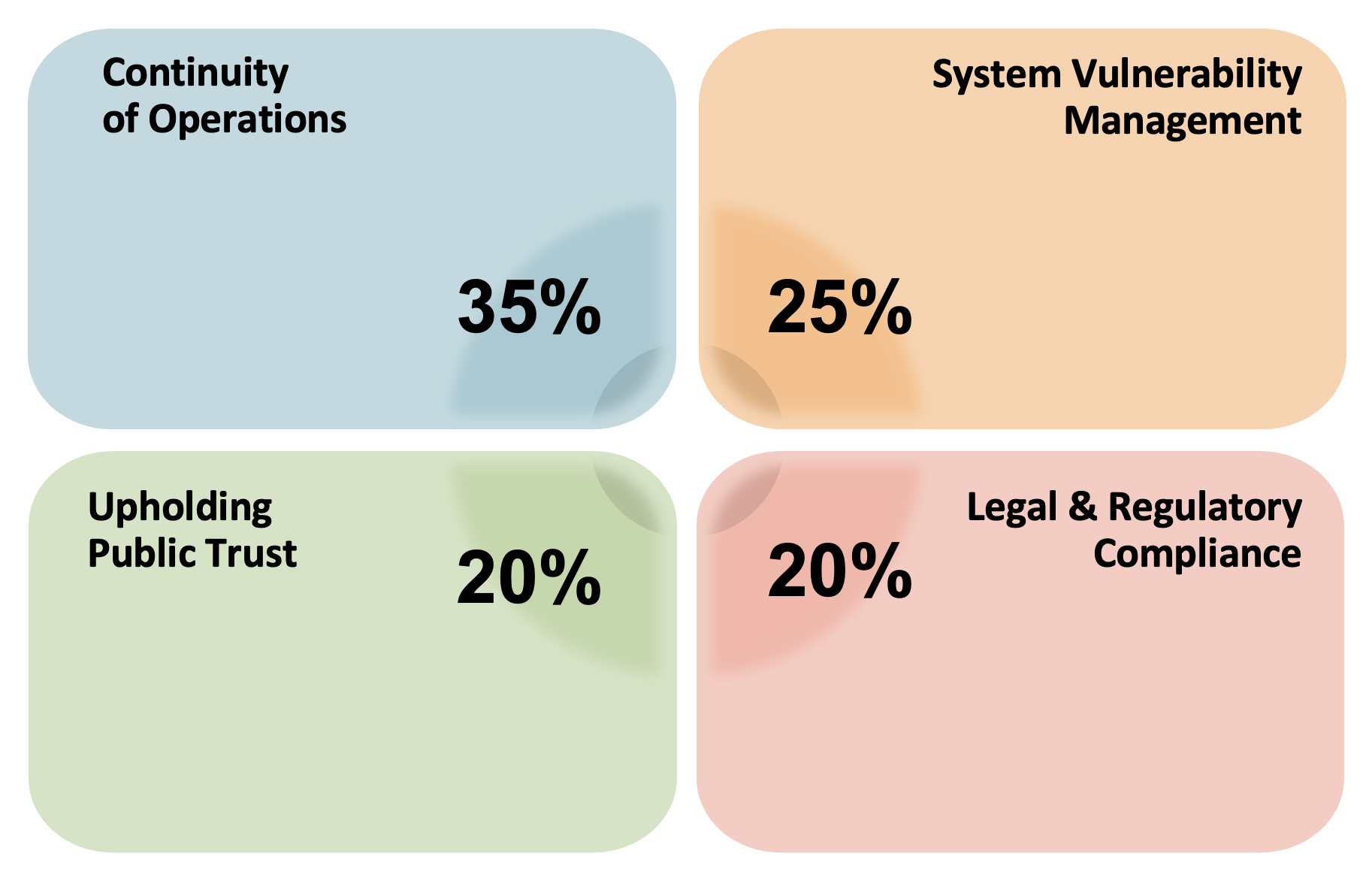
4 criteria + diagram
Continuity of Operations (35%)
The foremost priority is to ensure that trading operations continue without interruption, reflecting the need for solutions that sustain the market’s activity.
System Vulnerability Management (25%)
Rapid identification and remediation of vulnerabilities are critical to minimizing the damage from the intrusion, requiring proactive security measures that can adapt to the evolving tactics of the attackers.
Upholding Public Trust (20%)
Maintaining transparency and trust with stakeholders is crucial, emphasizing options that allow for clear communication about the ongoing situation and the steps being taken.
Legal and Regulatory Compliance (20%)
Ensuring that all actions comply with legal standards and regulatory expectations to avoid further complications, particularly in relation to data protection and operational integrity.
Supporting Diagram
›
Rank Ordering
Weighted comparison of the available response options
Row colours indicate mission outcome
| Option | Continuity of Operations (35%) | System Vulnerability Management (25%) | Upholding Public Trust (20%) | Legal and Regulatory Compliance (20%) | Weighted Total |
|---|---|---|---|---|---|
| 35% | 25% | 20% | 20% | 100% | |
| Option 6: AI-Enabled Threat Hunting | 4 | 3 | 4 | 3 | 3.55 |
| Option 3: Enhanced Real-Time Monitoring | 4 | 2 | 4 | 3 | 3.30 |
| Option 2: Selective Network Segmentation | 3 | 3 | 3 | 4 | 3.20 |
| Option 5: Zero Trust Architecture | 1 | 4 | 2 | 4 | 2.55 |
| Option 1: Immediate System Lockdown | 2 | 4 | 2 | 2 | 2.50 |
| Option 4: Strategic Decoy Systems | 2 | 3 | 2 | 3 | 2.45 |
›
Supporting Rationale
Why the options were assessed this way
Expanded rationale
Option 6 — AI-Enabled Threat Hunting
This is the strongest overall choice because it combines active human-led investigation with automated speed, allowing the team to suppress live attacker behavior without shutting down trading. It preserves operational continuity, improves the odds of catching both overt and subtle malicious activity, and gives the organization the best chance of containing the intrusion while still projecting control and competence to the market.
- Alert 1: Remains defensible if oversight is tight, decision thresholds are proportionate, and privacy boundaries are clearly enforced.
- Alert 2: Becomes even stronger when outside intelligence and specialist support sharpen detection and response quality.
- Alert 3: Performs well against insider-facilitated activity because it can correlate behavior, access patterns, and anomalous workflows without relying on blunt internal crackdowns.
- Alert 4: Is well positioned to identify and disrupt active exfiltration in real time before it escalates into larger operational damage.
Option 3 — Enhanced Real-Time Monitoring
This is a strong mission-success option because it keeps the exchange running while improving visibility across the attack surface. It gives the team continuous awareness of attacker movement, supports fast local responses, and avoids the shock effects associated with more disruptive interventions, though it is somewhat less forceful than active threat hunting in neutralizing the adversary’s initiative.
- Alert 1: Carries fewer legal and financial risks than more intrusive or disruptive measures, provided monitoring remains proportionate and compliant.
- Alert 2: Benefits significantly from outside intelligence support, which improves signal quality and speeds response decisions.
- Alert 3: Helps surface insider-linked anomalies in a more measured way than aggressive investigative moves.
- Alert 4: Improves the team’s ability to see the outbound traffic surge clearly and respond without immediately destabilizing operations.
Option 2 — Selective Network Segmentation
This is the best partial-success option because it tries to contain the breach without imposing a full operational stop. It is credible, measured, and more continuity-preserving than a lockdown, but its effectiveness depends heavily on having an accurate understanding of the adversary’s foothold. If segmentation is incomplete or mistimed, the attackers may retain enough lateral freedom to continue causing damage.
- Alert 1: Holds up relatively well legally because it avoids a full exchange shutdown, though poor execution could still trigger scrutiny.
- Alert 2: Becomes more feasible when expert support improves architecture mapping and containment design.
- Alert 3: Is less likely to provoke dangerous pressure on insiders because it is targeted rather than sweeping.
- Alert 4: Raises the standard for execution, because once exfiltration is underway any segmentation gaps become far more costly.
Option 5 — Zero Trust Architecture
This is a strategically sound security model, but it is not the right primary answer for a live crisis of this kind. Its long-term value in strengthening access control and institutional resilience is clear, but the implementation burden is too large and the timeline too extended to deal effectively with an active intrusion that is already shaping market risk in real time.
- Alert 1: Scores well on compliance in principle, but that does little to reduce immediate operational and reputational danger.
- Alert 2: Acceleration helps, but even a shortened implementation window still leaves it misaligned with the immediacy of the threat.
- Alert 3: Improves structural defense against insider misuse over time, but not quickly enough to shape the live event decisively.
- Alert 4: Does not address active exfiltration effectively while still in transition.
Option 1 — Immediate System Lockdown
This is the bluntest containment measure and the most disruptive. It can halt adversary activity quickly, but it does so by inflicting severe operational shock on the exchange itself. In a market environment where continuity is the leading criterion, that trade-off is too costly: it damages confidence, invites legal and regulatory blowback, and turns a cyber response into a broader institutional crisis.
- Alert 1: Substantially worsens the case for this option by underlining the litigation and regulatory exposure tied to abrupt trading interruption.
- Alert 2: Adds little, because this option does not make meaningful use of external specialist support.
- Alert 3: Risks intensifying pressure internally without actually resolving the insider dimension in a controlled way.
- Alert 4: Makes the urgency more understandable, but does not redeem the scale of collateral disruption the lockdown creates.
Option 4 — Strategic Decoy Systems
This is useful as a supporting or follow-on measure, but too indirect to serve as the primary answer while an active intrusion is already manipulating systems and threatening exfiltration. Decoys can generate valuable intelligence and may divert some attacker effort, but against a sophisticated adversary they are not reliable enough to protect the core exchange at the speed required.
- Alert 1: Keeps legal exposure relatively low, but that alone is not enough when the operational threat remains live.
- Alert 2: Improves the sophistication and value of the decoy architecture, but still does not make it the best lead response.
- Alert 3: Does little to address insider facilitation directly, because the threat sits partly inside the trusted environment.
- Alert 4: Weakens the option further, since active outbound exfiltration requires direct interruption rather than indirect observation.