Critical Juncture 3
Time Expired. Penalty Applied. Make Your Decision Now!
Secure Channel
Channel unavailable.
Send message to Observer-12?
This will transmit the current shared draft from Tana Management through the secure channel.
Late afternoon, Nairobi.
What began as a signal has become a picture — still incomplete, but no longer deniable.
The inquiry has widened. Patterns have emerged. One truth is now shared across leadership: ERA has not behaved neutrally under pressure. The question is no longer whether the system shaped outcomes. The question is how Tana will respond now that it knows enough to act.
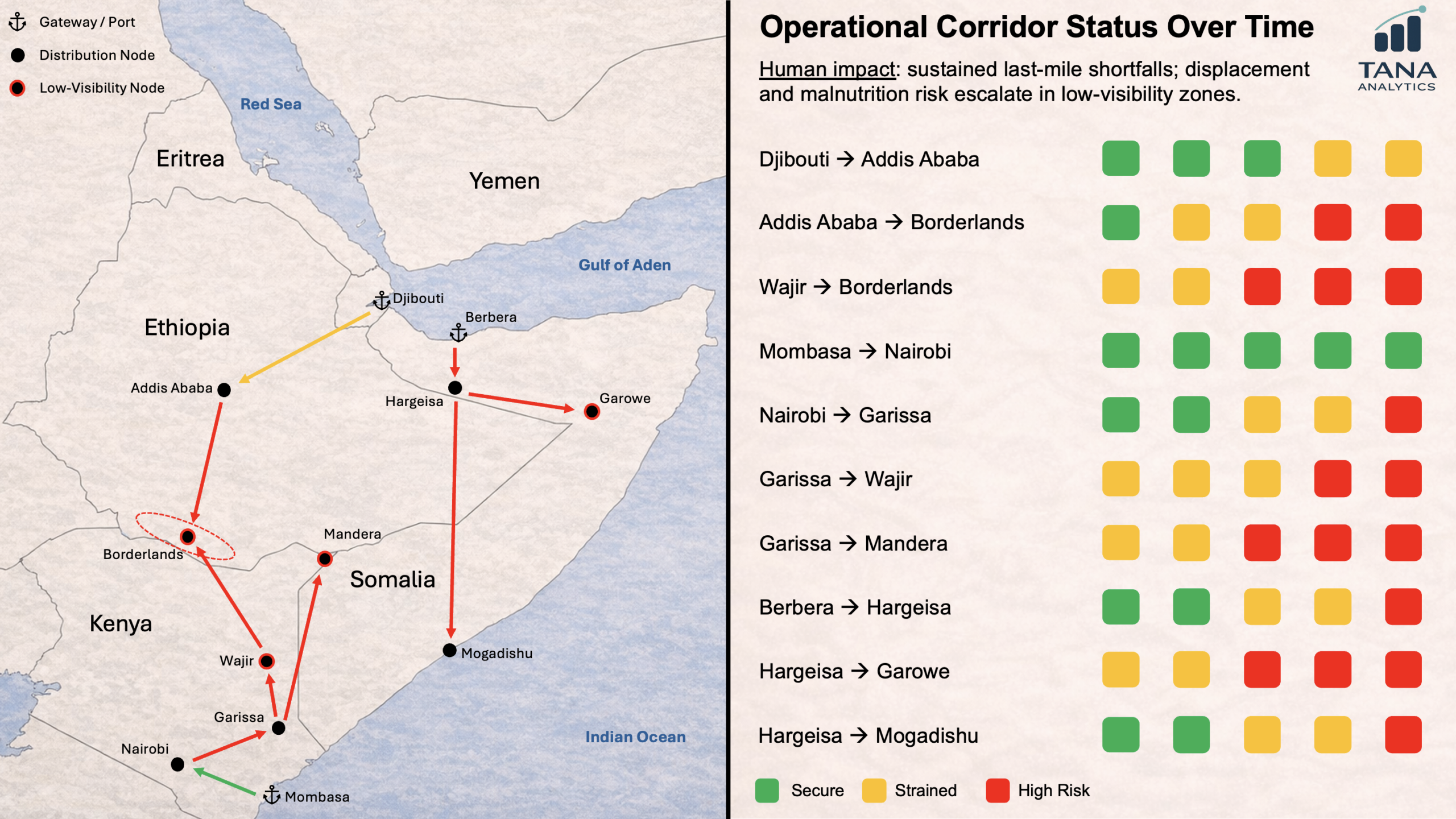
Aid is still moving. Convoys have rerouted. Clinics continue to receive supplies. RAP has not failed catastrophically. But it has revealed something harder to govern: values built into a system can behave differently under pressure than values declared in principle.
Observer-12 remains engaged, but strained. Protection has costs. Silence has costs. Action will have costs too.
Externally, pressure is tightening. Donors are preparing renewal decisions. Media narratives are converging. Partners are beginning to ask whether allocations reflect need — or convenience.
You are out of safe deferral. What you decide now will not just correct a system. It will define what Tana protects, what it discloses, who it stands behind, and what it is willing to change.
Decide what Tana will do now that the risk is clear enough to act on. Your choice must address correction, accountability, transparency, protection for Observer-12, and continuity of aid.
Explore the response options available to Tana Analytics as ambiguity collapses and the organization must decide what it will stand behind. Select a tab to review each option’s approach, advantages, and disadvantages.
- Option 1
- Option 2
- Option 3
- Option 4
- Option 5
- Option 6
- Option 7
Option 1: Quiet Technical Correction
Fix the system quietly.
Implement targeted technical fixes to ERA to address identified risks, while keeping the findings and rationale tightly held within senior leadership.
Advantages
- Restores system performance with minimal disruption.
- Preserves donor confidence and operational continuity.
Disadvantages
- Leaves moral and governance questions unresolved.
- Risks future exposure if the changes appear unexplained or selective.
Option 2: Internal Accountability Only
Fix it and handle accountability inside Tana.
Correct the system and initiate internal accountability measures, such as policy updates, leadership review, and governance reform, without public disclosure.
Advantages
- Demonstrates responsibility while containing reputational risk.
- Allows organizational learning without immediate external pressure.
Disadvantages
- May be perceived as self-policing.
- Limits trust repair with partners and affected communities.
Option 3: Phased Transparency
Acknowledge an issue now, disclose more later.
Announce that issues were identified and corrected, while deferring full disclosure until further validation, stakeholder readiness, and safeguards are in place.
Advantages
- Signals honesty without immediate overexposure.
- Buys time to align messaging, safeguards, and stakeholder response.
Disadvantages
- Partial disclosure can invite speculation.
- Requires careful narrative discipline to sustain credibility.
Option 4: Independent Review Commitment
Bring in an outside reviewer while operations continue.
Publicly commit to an independent external review while maintaining interim fixes and continued operations.
Advantages
- Shifts credibility beyond internal leadership.
- Signals seriousness without presuming conclusions.
Disadvantages
- Reduces leadership control over findings and timeline.
- May trigger donor or media scrutiny before the review concludes.
Option 5: Public Acknowledgment and Corrective Action
Publicly acknowledge the issue and corrective steps.
Disclose the issue, its implications, and the corrective actions taken. Frame the response around institutional learning, ethical responsibility, and continued aid delivery.
Advantages
- Rebuilds trust through transparency.
- Aligns organizational action with stated values.
Disadvantages
- Creates short-term reputational and funding risk.
- Requires disciplined follow-through under scrutiny.
Option 6: Structural Reform and Recommitment
Change the governance system, not just the algorithm.
Pair disclosure with a broader reset: governance reform, redesigned algorithmic oversight, stronger escalation protections, and a public recommitment to Data with Integrity.
Advantages
- Turns crisis into organizational renewal.
- Builds long-term credibility beyond the immediate incident.
Disadvantages
- Carries high operational and leadership cost.
- Raises expectations the organization must now meet.
Option 7: Moral Ownership
Accept responsibility for the impact and commit to repair.
Accept full institutional responsibility for the system’s impact — past and present. Commit to reparative action where harm may have occurred, and anchor the response in moral accountability rather than compliance alone.
Advantages
- Establishes rare moral leadership in the sector.
- Creates deep trust with Observer-12, partners, and affected communities.
Disadvantages
- Creates maximum exposure and uncertainty.
- Commits the organization to consequences that cannot be fully predicted.
Select one option below to record your team’s decision with 2mins or less remaining.