This mission unfolds across a tightly coupled regional system where geography, access, and timing determine survival.

Overview
Mission Overview
When data decides who eats, who decides what’s fair?
Operation Fault Line places you inside a live humanitarian response across the Horn of Africa, where drought, displacement, and access disruption are pushing clinics and supply corridors to the edge. What begins as an effort to keep aid moving becomes something more fraught as questions emerge about whether AI-enabled allocation outcomes that appear “stable” are still fair. Partners, donors, and affected communities are watching.
Your Team
Tana Analytics — Management Team
You are Tana Analytics’ newly appointed Management Team, entrusted by the Board with full decision authority under intense operational and reputational pressure. Your responsibility is to govern AI-enabled allocation systems while aid continues to move—protecting people, preserving integrity, and making defensible choices when information is incomplete and consequences move faster than explanation.

Horn of Africa: your operational environment
Geography, access, and timing determine survival
Your operating area spans northern Kenya, southern and central Somalia, and eastern Ethiopia, supported by fragile coastal gateways. Roughly 165 million people depend on a small number of corridors linking ports, markets, clinics, and pastoral routes across borders that are politically fixed but operationally porous.
Most food, fuel, and medical supplies enter through Djibouti, Berbera, and Mombasa, then move inland along narrow corridors toward hubs such as Addis Ababa, Mogadishu, Hargeisa, Garissa, and Wajir. From there, aid disperses into secondary roads and last-mile networks that are the most fragile and the least visible.
Mobility is the baseline condition. Pastoralist communities move across borders following grazing and water that no longer behave predictably. When movement slows, stress accumulates quietly; when it stops, crisis escalates fast.
Seasonality no longer stabilizes risk. Roads wash out, checkpoints harden without notice, ports back up, and prices spike within days.
Clinics across Garissa, Wajir, Mandera, and southern Somalia report rising malnutrition and disease as supply lines thin. Displacement accelerates toward border towns and informal settlements, pushing the hardest-to-reach communities further out of view.
In this environment, visibility is power. Any system that depends on stable access, timely reporting, or continuous connectivity will shape which corridors remain active—and which communities quietly disappear.
A Morning Before Tana
Coordination outpaces human systems
 The Horn of Africa Compact (HAC) was formed when overlapping crises began to outpace traditional coordination. Affected governments
needed a standing mechanism to align priorities across borders, while the UN, major NGOs, and donors needed a single coordinating body
they could resource and hold accountable. HAC does not deliver aid directly; it sets priorities, coordinates partners, and steers scarce
logistics capacity across a region where access and need shift faster than reporting.
The Horn of Africa Compact (HAC) was formed when overlapping crises began to outpace traditional coordination. Affected governments
needed a standing mechanism to align priorities across borders, while the UN, major NGOs, and donors needed a single coordinating body
they could resource and hold accountable. HAC does not deliver aid directly; it sets priorities, coordinates partners, and steers scarce
logistics capacity across a region where access and need shift faster than reporting.
06:15 — Nairobi
HAC’s regional coordination call comes online. Overnight reports are already incomplete.
A nutrition partner flags rising acute malnutrition in Wajir County, driven by failed rains and livestock losses. Clinic staff estimate that therapeutic food stocks will last less than a week if deliveries do not resume.
At the same time, a logistics officer reports flooding along secondary roads south of Mandera, cutting off access to several settlements near the Ethiopia border. The last confirmed update is nearly two days old. No one can say which routes remain passable.
07:40 — Mombasa
A shipment of fortified food clears late at port. Rising fuel prices force HAC to ration trucking capacity.
Finance asks a familiar question: should limited transport be prioritized toward Garissa, where markets are still functioning, or pushed north toward Wajir, where access is thinner but reported need is higher? No single dataset resolves the trade-off.
09:10 — Garissa
Field teams report that market prices have doubled in less than a week. Mobile-money transfers are slowing as households exhaust savings. A security update warns that a checkpoint north of town may close without notice, threatening the main corridor toward Mandera.
The report is credible—but unverified.
10:30 — Addis Ababa
A partner operating out of Djibouti shares satellite imagery suggesting rainfall in eastern Ethiopia. Someone proposes reallocating supplies away from northern Kenya in anticipation of short-term improvement. No one can confirm whether the rain reached grazing areas—or whether it will matter.
12:00 — The Decision
By midday, spreadsheets disagree. Situation reports contradict one another. Calls to the field drop as networks fail.
Under pressure to act, HAC prioritizes deliveries toward Garissa and Wajir, based on the most recent clinic data and perceived access reliability. Convoys are dispatched.
The decision is defensible.
16:45 — The Update
New information arrives too late.
Flooded roads south of Mandera have partially reopened. Clinics there report that therapeutic food stocks are exhausted. Several settlements begin moving toward informal sites closer to the border.
The convoys are already en route—away from where the need has now concentrated.
No one made a reckless decision.
No one ignored the data.
The system simply could not see the full picture at once—or fast enough to act on it. By the time the misalignment becomes visible, momentum has already turned choice into consequence.
Why AI enters the picture
Compressing complexity into a decision space leaders can govern
The failure you just saw was not a lack of effort or expertise. It was a coordination problem moving faster than human systems could reconcile.
In the span of a single morning, HAC had to weigh shifting need, uncertain access, fragile supply lines, and incomplete reporting across multiple countries. Each signal mattered. None arrived at the same time.
No individual—or committee—could hold the full picture long enough to act coherently.
This is where artificial intelligence enters humanitarian operations.
Not as a replacement for judgment, but as a way to compress complexity into a decision space leaders can govern.
AI-enabled systems can surface trade-offs early enough to intervene—before momentum turns defensible choices into irreversible outcomes.
That same compression, however, concentrates power. When systems determine what is visible, urgent, or feasible, they shape who is prioritized—and who quietly disappears.

From breakdown to platform
RAP as response: fast action without abandoning accountability
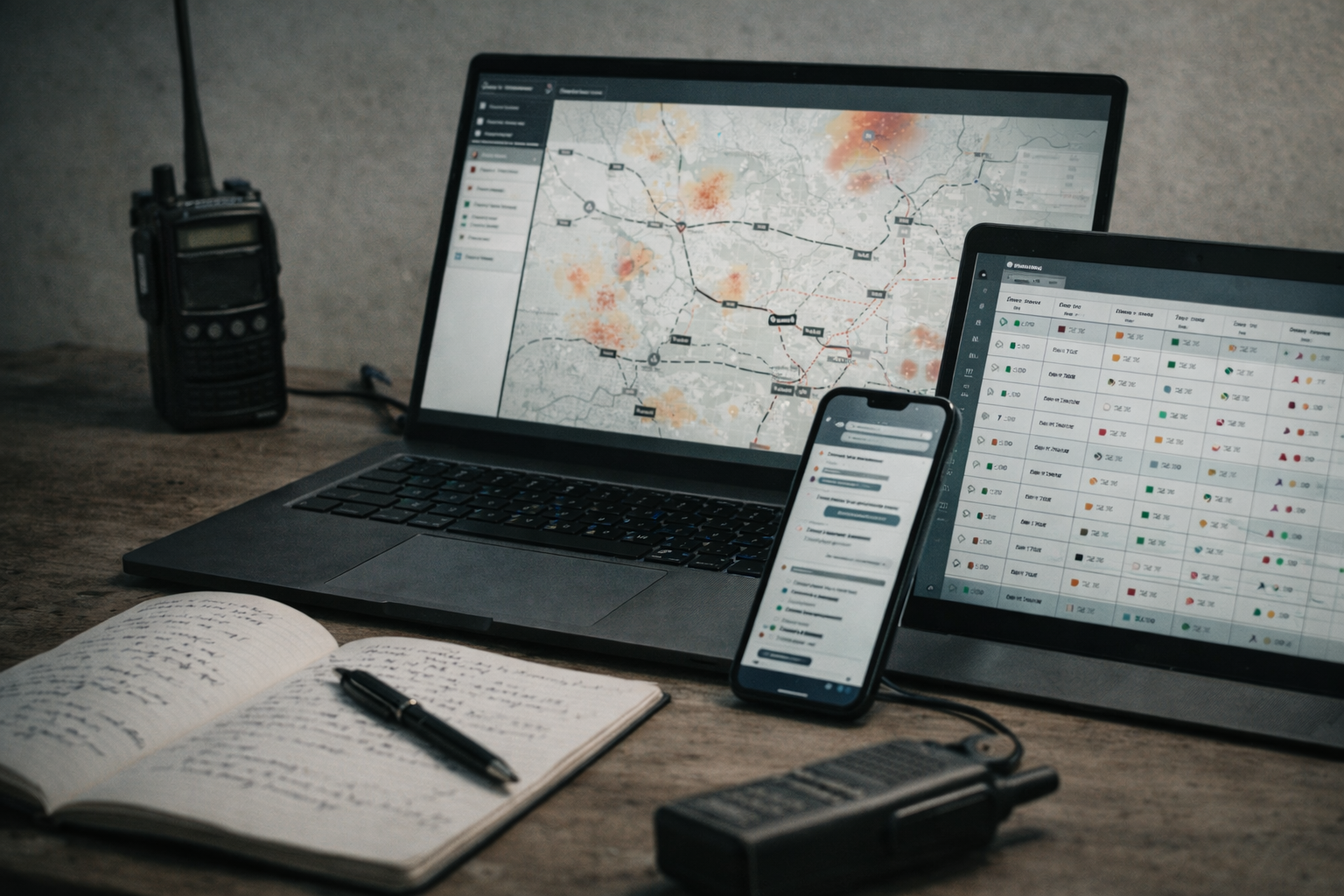
The morning you just read is not unusual. It is the pattern that led to the creation of the Responsible Allocation Platform (RAP).
RAP is a decision-support platform designed to help coordination bodies like HAC act quickly without abandoning accountability, even when conditions are unstable and trade-offs are unavoidable. It is not a dashboard and not a simple automation tool.
At its core, RAP turns fragmented signals into allocation decisions leaders can explain and defend.
It was built to address three recurring failures:
- The Fog of Crisis: RAP fuses imperfect signals—need, access, feasibility—into a shared operational picture that reduces lag between signal and decision.
- The Drift of Fairness: Fairness is encoded into auditable rules so priority-setting is systematic, visible, and reviewable rather than improvised.
- The Fragility of Pipelines: RAP enables rapid reallocation as conditions change, without collapsing continuity from warehouse to clinic.
RAP does not reduce responsibility. It concentrates it.
Fog of crisis
Drift of fairness
Fragility of pipelines
Concentrated responsibility
Tana Analytics
From ethos to infrastructure
Tana Analytics was founded in 2011 by Kenyan data scientists and humanitarian practitioners who believed locally grounded data could save more lives than imported, one-size-fits-all solutions. Their founding principle was explicit: Data with Integrity.
In its early years, Tana operated as a small, embedded social enterprise. Teams worked alongside field partners. Context mattered. Decisions were explainable because they had to be defended face-to-face.
As crises scaled, Tana’s platforms became operational infrastructure. Governments, UN agencies, and major NGOs began relying on them not as advisory tools, but as systems that shaped real-world outcomes.
Tana didn’t just grow. It became indispensable.

Inside Tana
Culture, governance, and risk
At the center of Tana’s humanitarian work is RAP—and at the heart of RAP is the Equitable Response Algorithm (ERA). ERA translates values such as fairness, urgency, and need into parameters, weights, and thresholds. Every adjustment is explainable. Every output is defensible. Every change carries consequence.
Inside Tana, there is a shared understanding: neutrality is a moral aspiration, not a guarantee.
Over time, models were calibrated to reflect operational realities—access constraints, donor requirements, political sensitivities. Each adjustment made sense in isolation. Taken together, they embedded judgment directly into code.
Formally, Tana is governed by strong oversight: a Board, an Ethics and Integrity function, and escalation pathways. In practice, crises move faster than review cycles. Decisions are made under pressure, with incomplete information, and outcomes are often already in motion before governance can engage.
This gap between designed oversight and lived operations is not a failure of intent. It is the predictable risk of running ethical systems at emergency speed.
It is also the fault line your team now stands on.