This mission unfolds across a region where geography, access, and timing can determine who receives help in time — and who does not.
Overview
Mission Overview
Operation Fault Line places you inside a live humanitarian response across the Horn of Africa. Drought, displacement, and disrupted access are pushing clinics and supply corridors to the edge.
Tana Analytics’ AI-enabled allocation platform is helping decide where scarce aid should go first. At first, the system appears to be keeping aid moving. But questions are beginning to surface: are the “stable” allocation outcomes still fair, or are some hard-to-reach communities being pushed out of view?
Partners, donors, and affected communities are watching. The decisions your team makes will shape who is protected, what is investigated, and whether Tana can still be trusted.
Your Team
Tana Analytics — Management Team
You are Tana Analytics’ newly appointed Management Team. The Board has given you full decision authority at a moment of intense operational and reputational pressure.
Your responsibility is to keep aid moving while governing the AI-enabled systems that influence who receives help first. You will need to protect people, preserve integrity, and make defensible choices with incomplete information.
Soon, an internal whistleblower will raise concerns about the allocation system. How you respond will determine what you learn, what options remain open, and whether your leadership is seen as credible.

Horn of Africa: your operational environment
Geography, access, and timing determine survival
Your operating area spans northern Kenya, southern and central Somalia, and eastern Ethiopia. Roughly 165 million people depend on a small number of routes linking ports, markets, clinics, and pastoral communities across borders. On a map, these borders look fixed. In daily life, people, livestock, trade, and aid move across them constantly.
Most food, fuel, and medical supplies enter through Djibouti, Berbera, and Mombasa, then move inland toward hubs such as Addis Ababa, Mogadishu, Hargeisa, Garissa, and Wajir. From there, supplies must travel through smaller roads and last-mile networks that are fragile, hard to monitor, and easy to miss in the data.
When corridors hold, markets function and clinics cope. When they break down, shortages spread quickly and unevenly. A town that looks stable early in the week can face acute shortages by the weekend.
Years of drought have erased local buffers. Herds have collapsed, wells have failed, and families are selling assets or skipping meals. Clinics across Garissa, Wajir, Mandera, and southern Somalia are reporting rising malnutrition and disease as supply lines thin. Displacement is increasing toward border towns and informal settlements, pushing the hardest-to-reach communities further out of view.
In this environment, visibility is power. If a community reports late, loses connectivity, or becomes harder to reach, the system may read that as lower priority rather than higher risk. Any AI-enabled allocation system must therefore be judged not only by how efficiently it moves aid, but by whether it protects the people who are hardest to see.
A Morning Before Tana
Coordination outpaces human systems
 The Horn of Africa Compact, or HAC, was created because crisis coordination had become too complex for any one government, NGO, or donor to manage alone. HAC does not deliver aid directly. It sets priorities, coordinates partners, and helps decide where limited logistics capacity should go when needs are changing faster than reports can keep up.
06:15 — Nairobi
HAC’s regional coordination call begins. Overnight reports are already incomplete.
A nutrition partner reports rising acute malnutrition in Wajir County. Clinic staff estimate that therapeutic food stocks will last less than a week unless deliveries resume.
At the same time, a logistics officer reports flooding south of Mandera, cutting off several settlements near the Ethiopia border. The last confirmed update is nearly two days old. No one can say which routes are still passable.
07:40 — Mombasa
A shipment of fortified food clears late at port. Rising fuel prices mean HAC cannot move everything at once.
The team faces a familiar trade-off: send limited transport toward Garissa, where markets are still functioning and access looks more reliable, or push farther north toward Wajir, where reported need is higher but access is thinner. No single dataset resolves the choice.
09:10 — Garissa
Field teams report that market prices have doubled in less than a week. Mobile-money transfers are slowing as households run out of savings. A security update warns that a checkpoint north of town may close without notice, threatening the corridor toward Mandera.
The report is credible, but not yet verified.
10:30 — Addis Ababa
A partner operating out of Djibouti shares satellite imagery suggesting rainfall in eastern Ethiopia. Someone proposes shifting supplies away from northern Kenya in case conditions improve. No one can confirm whether the rain reached grazing areas, or whether it will change the need on the ground.
12:00 — The Decision
By midday, the information does not line up. Spreadsheets disagree. Situation reports contradict one another. Calls to the field drop as networks fail.
Under pressure to act, HAC prioritizes deliveries toward Garissa and Wajir using the most recent clinic data and the routes that appear most reliable. Convoys are dispatched.
The decision is reasonable based on what HAC knows at the time.
16:45 — The Update
New information arrives too late.
Flooded roads south of Mandera have partially reopened. Clinics there report that therapeutic food stocks are exhausted. Several settlements begin moving toward informal sites closer to the border.
The convoys are already en route — away from where the need has now concentrated.
No one made a reckless decision. No one ignored the data. But the system could not see the full picture quickly enough. By the time the gap becomes visible, the decision has already become a consequence.
Why AI enters the picture
Compressing complexity into a decision space leaders can govern
The failure you just saw was not caused by a lack of effort or expertise. It happened because the situation changed faster than people and reporting systems could keep up.
In a single morning, HAC had to weigh changing needs, uncertain access, fragile supply lines, and incomplete reports across multiple countries. Each signal mattered, but the signals arrived at different times and pointed in different directions. No person, team, or committee could hold the full picture clearly enough for long enough.
This is why AI enters humanitarian operations.
Used well, AI does not replace human judgment. It helps leaders see patterns, compare trade-offs, and make decisions before delays become harmful. It can help show where aid is needed, where access is possible, and where risks are rising.
But that same power creates danger. If the system decides what counts as visible, urgent, or reliable, it also shapes who gets priority — and who may be missed. In a crisis, the people who are hardest to see in the data may also be the people most at risk.

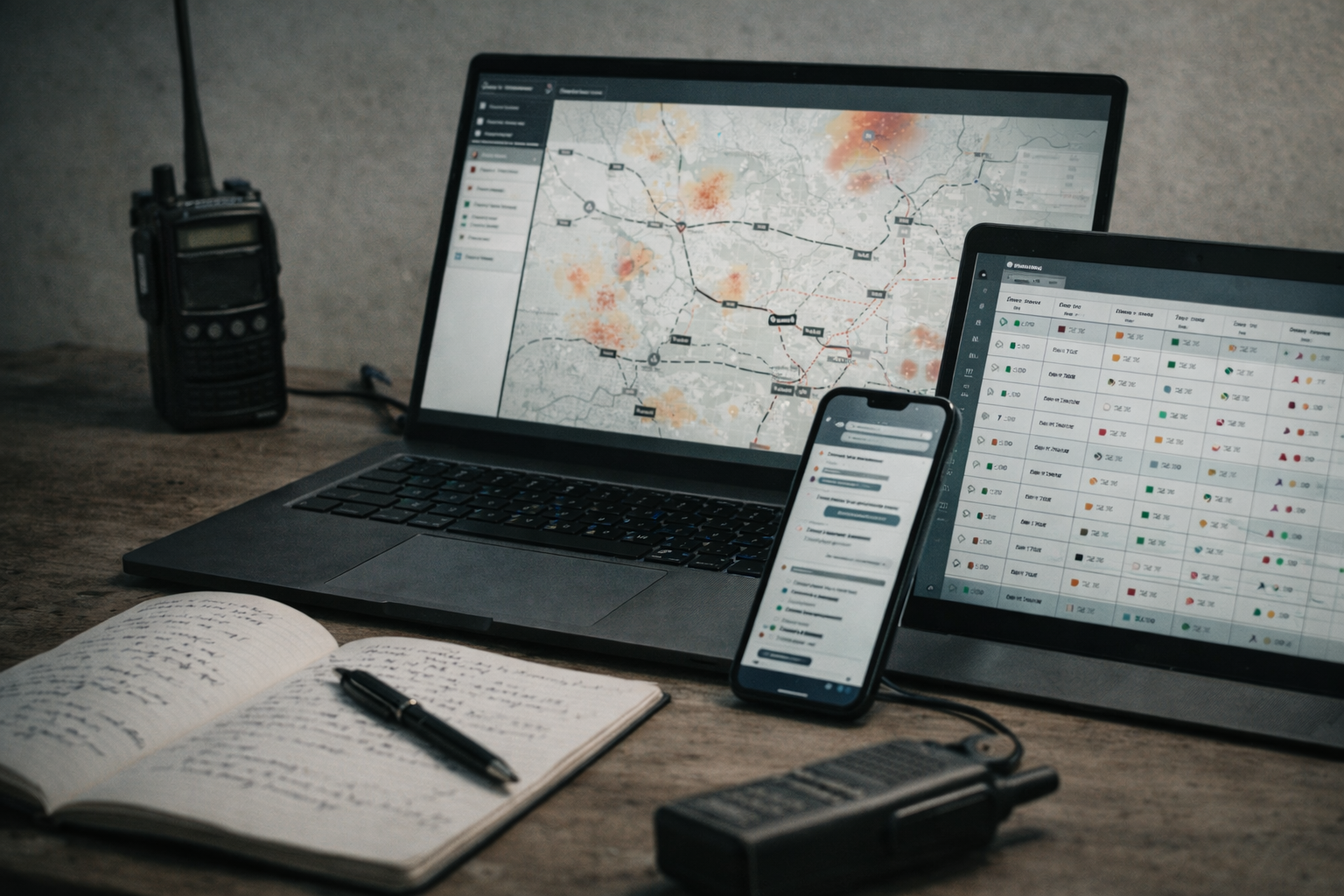
From breakdown to platform
RAP as response: fast action without abandoning accountability
The morning you just read is not unusual. It is the kind of breakdown that led to the creation of the Responsible Allocation Platform, or RAP.
RAP is a decision-support platform that helps coordination bodies like HAC decide where scarce aid should go when conditions are changing quickly and trade-offs are unavoidable. It is not meant to replace leaders, and it is not just a dashboard.
At its core, RAP takes fragmented signals — such as need, access, supply, and feasibility — and turns them into allocation recommendations that leaders can review, explain, and challenge.
RAP was built to address three recurring problems:
- Crisis fog: Information arrives late, incomplete, or in conflict. RAP helps combine imperfect signals into a shared operating picture.
- Fairness drift: Under pressure, priority-setting can become improvised or inconsistent. RAP is meant to make the rules for prioritization more visible, systematic, and reviewable.
- Fragile pipelines: Conditions can change quickly between warehouse and clinic. RAP helps leaders adjust allocations as routes, supply levels, and access risks change.
RAP does not remove human responsibility. It makes leadership responsibility more concentrated: the better the system works, the more important it becomes to govern it carefully.
Crisis fog
Fairness drift
Fragile pipelines
Concentrated responsibility
Tana Analytics
From ethos to infrastructure
Tana Analytics was founded in 2011 by Kenyan data scientists and humanitarian practitioners who believed locally grounded data could save more lives than imported, one-size-fits-all solutions. Their founding principle was clear: Data with Integrity.
In its early years, Tana was a small, embedded social enterprise. Its teams worked directly with field partners. Context mattered. Decisions had to be explainable because the people affected by them were close enough to question them.
As crises grew larger and more complex, Tana’s platforms became part of the region’s humanitarian infrastructure. Governments, UN agencies, and major NGOs began relying on them not just for advice, but to shape real-world allocation decisions.
Tana did not just grow. It became indispensable — and that made its choices harder to question.

Inside Tana
Culture, governance, and risk
At the center of Tana’s humanitarian work is RAP. At the heart of RAP is the Equitable Response Algorithm, or ERA. ERA helps translate values like fairness, urgency, and need into system settings: parameters, weights, and thresholds that influence allocation recommendations. Every adjustment can be explained. Every output can be defended. But every change also affects who may receive help first.
Inside Tana, people understand that neutrality is the goal, not a guarantee.
Over time, RAP and ERA were adjusted to reflect operational realities: access constraints, donor requirements, security risks, and political sensitivities. Each adjustment may have made sense on its own. But together, these choices embedded human judgment directly into the system.
On paper, Tana has strong oversight: a Board, an Ethics and Integrity function, and escalation pathways for concerns. In practice, crises move faster than review cycles. Decisions are made under pressure, with incomplete information, and outcomes are often already in motion before governance can fully catch up.
This gap between formal oversight and real-time operations is not necessarily a failure of intent. It is the predictable risk of running high-stakes ethical systems at emergency speed.
That is the fault line your team now stands on.