Silk Threads - Mission Headquarters

Overview

Mission Overview

Operation Silk Threads drops your team into the high-stakes world of preparing the EcoLux collection for a Paris Fashion Week runway debut. What begins as a glamorous product launch quickly spirals into a web of complications: global events disrupt logistics, outside scrutiny intensifies, and questions emerge about the integrity of your supply chain. Activists, investors, and buyers are watching.

Your challenge is to steer Silk Threads Global (STG) through this storm, balancing speed with sustainability, profit with principle, and style with substance. The impact of your decisions will stretch from Paris catwalks to Bangladeshi mills. Success could redefine ethical luxury; failure could unravel the trust at the heart of the company.

Watch the mission brief to understand the tension between ethical sourcing, runway deadlines, and public perception.
Your Team

The STG leadership collective

You are the newly appointed management team of Silk Threads Global (STG), a collective voice spanning design, production, finance, sustainability, and marketing. From Milan to Da Nang, your team must weave STG’s European–South Asian identity into every choice.

Every decision you make will be read through multiple lenses — creative excellence, ethical sourcing, operational realism, and market impact. You don’t just represent a brand; you represent a contested vision of what ethical luxury should look like.

  • Creative direction
  • Sustainable operations
  • Financial discipline
  • Global comms
STG management team for Operation Silk Threads
STG’s core team spans Europe and South/Southeast Asia — decisions must land well in both regions.
Silk Threads — origins to present day

From a Florentine idea to an ethical, global house

1995 — Florence and the first spark

STG began as a whisper of an idea in 1995. Its founder, Alessandra Bianchi, grew up moving between Renaissance galleries and the sound of her grandmother’s sewing machine in Florence. Known for avant-garde instincts and a stubborn respect for heritage craft, she built early collections around locally woven silk and couture techniques, blending century-old handwork with modern silhouettes. The fashion press loved that mix, and her designs started to live in people’s imagination, not just on runways.

Early 2000s — reaching Milan and Paris

As demand grew, the brand stepped out of Florence toward Milan and Paris, opening design studios and partnering with ateliers across Europe. With luxury appetite soaring, STG moved into ready-to-wear, accessories and fragrances, building a presence across a woman’s whole wardrobe. By 2010, though, it was competing not just with other houses but with fast-fashion players pushing trends every week. That raised hard questions about where materials came from and who was making them.

2010 — choosing transparency

Bianchi listened. She saw that the future of luxury would rest as much on ethics, traceability and environmental stewardship as on embellishment. So STG slowed down where others sped up, and began to remake its supply approach around what it could stand behind in public.

2014 — Gazipur, Bangladesh

Crossing continents, STG opened a modern facility in Gazipur, Bangladesh, drawn by local textile skill and a tradition of handwork that matched the brand’s standards. That move let STG stay price-competitive while investing in fair wages and safe conditions — a calculated blend of commerce and conscience.

2020 — becoming Silk Threads Global

By 2020 the company was ready to show what it had become. Rebranding as Silk Threads Global signalled that its centre of gravity was now European design plus global collaboration. The EcoLux collection is the latest expression of that: proof that luxury and sustainability can sit in the same garment.

Alessandra Bianchi in an earlier studio setting with fabrics and sketches
Alessandra in her studio years — Florence, couture finishing, locally woven silk.
Alessandra Bianchi on site during STG's expansion phase
As the brand expanded, she kept the craft language, even in cross-regional partnerships.
Ownership & organizational structure

Creative control, private-equity pressure, and shared stakeholding

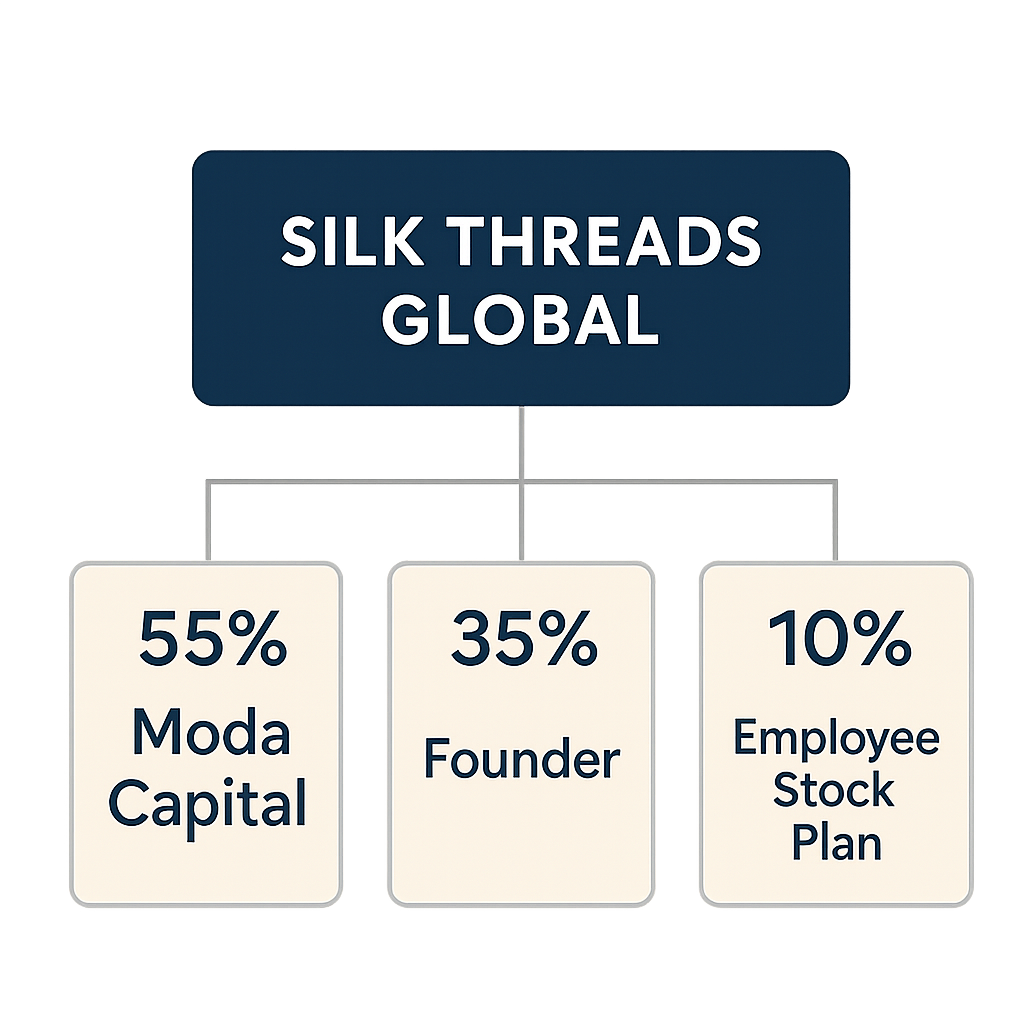
In 2022, the founders realised that art alone could not finance ambition. STG sold 55% of its equity to Moda Capital, a European private-equity fund that says it focuses on sustainable luxury. Alessandra Bianchi kept 35% and still leads creative direction, while the remaining 10% sits with employees through stock ownership plans. That mix — creative, corporate and communal — now shows up in most decisions.

Four interlocking divisions

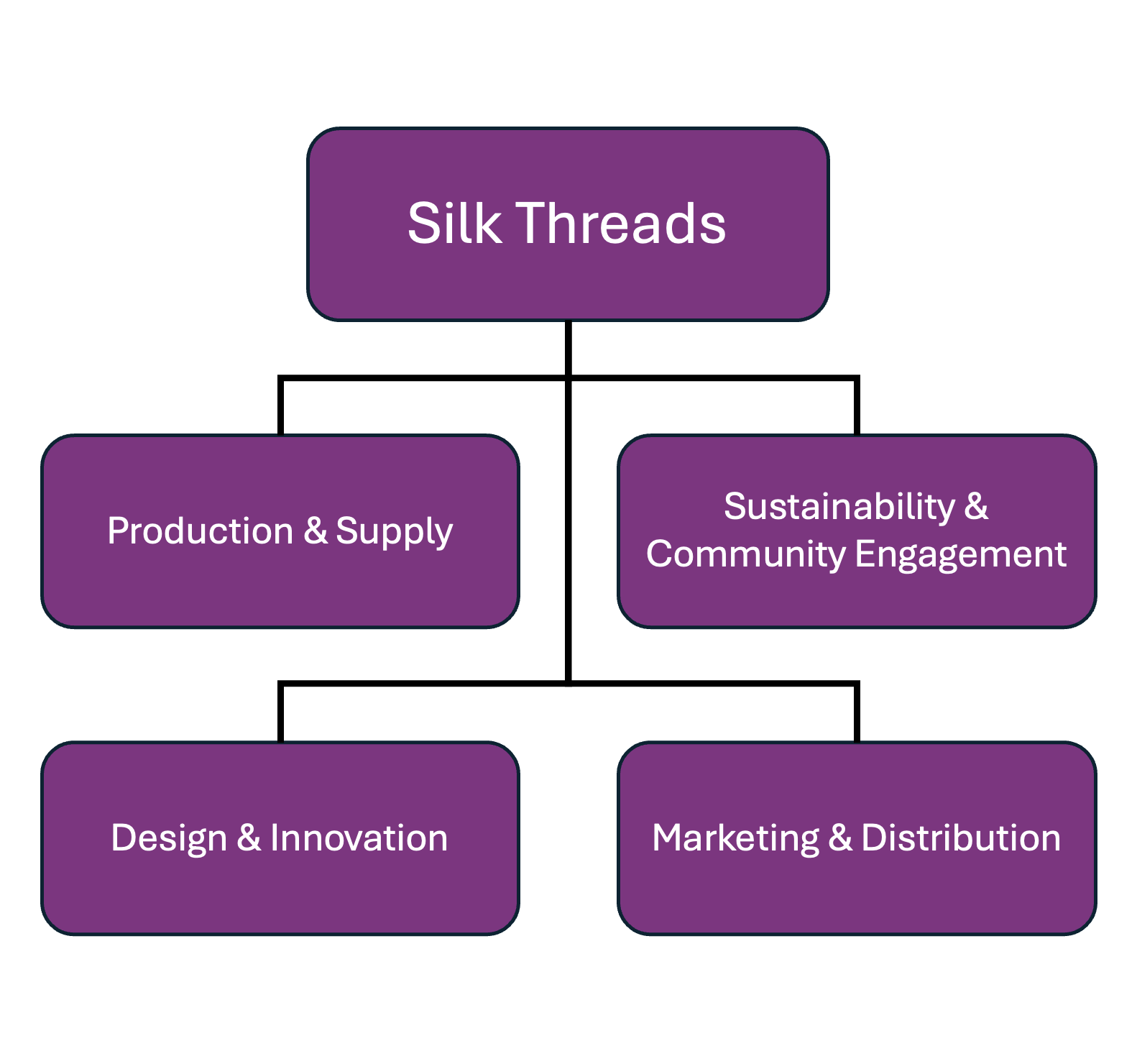
The company is organised into four main divisions:

  • Design & Innovation. Concept development, trend work and prototypes. Still based in Milan and Paris.
  • Production & Supply. Manufacturing, QC and supply-chain logistics. Flagship plant in Gazipur, Bangladesh, with partner workshops in Vietnam and Turkey.
  • Sustainability & Community Engagement. Environmental compliance, ethical labour and community investment.
  • Marketing & Distribution. Brand comms, digital, retail partnerships and global distribution.

These divisions don’t work in isolation; they cross like warp and weft. Design checks supply before committing to a runway direction. Sustainability works with finance to defend community spend. Marketing turns atelier language into stories that travel from Paris to Dhaka. The structure itself says: beauty and business get woven together.

STG ownership structure showing Moda Capital, Alessandra Bianchi, and employee share
Ownership after 2022: PE majority, creative founder, employee stake.
Silk Threads Global org chart with four divisions
Four divisions linked across Europe and South/Southeast Asia.
Governance

Co-chairs to keep art and operations in the same room

After the Moda Capital investment, STG moved to a co-chair model so that creative vision and operational realities would both be present at board level. The board is co-chaired by Alessandra Bianchi and Rahim Ahmed.

Bianchi brings a European design lens and a refusal to dilute the brand’s craft standards. Ahmed, a Bangladeshi entrepreneur and advocate for workers’ rights, has decades of experience leading textile cooperatives in Dhaka, so manufacturing, labour and community perspectives are actually in the room when strategy gets set.

The model balances ambition with accountability, but it also introduces tension — the co-chairs don’t always align on speed-to-market, worker welfare or how much transparency to offer buyers and activists.

STG co-chairs Alessandra Bianchi and Rahim Ahmed
Co-chairs: Bianchi (creative, European) and Ahmed (Bangladeshi, worker-focused).
Market competition

Holding space between luxury and premium

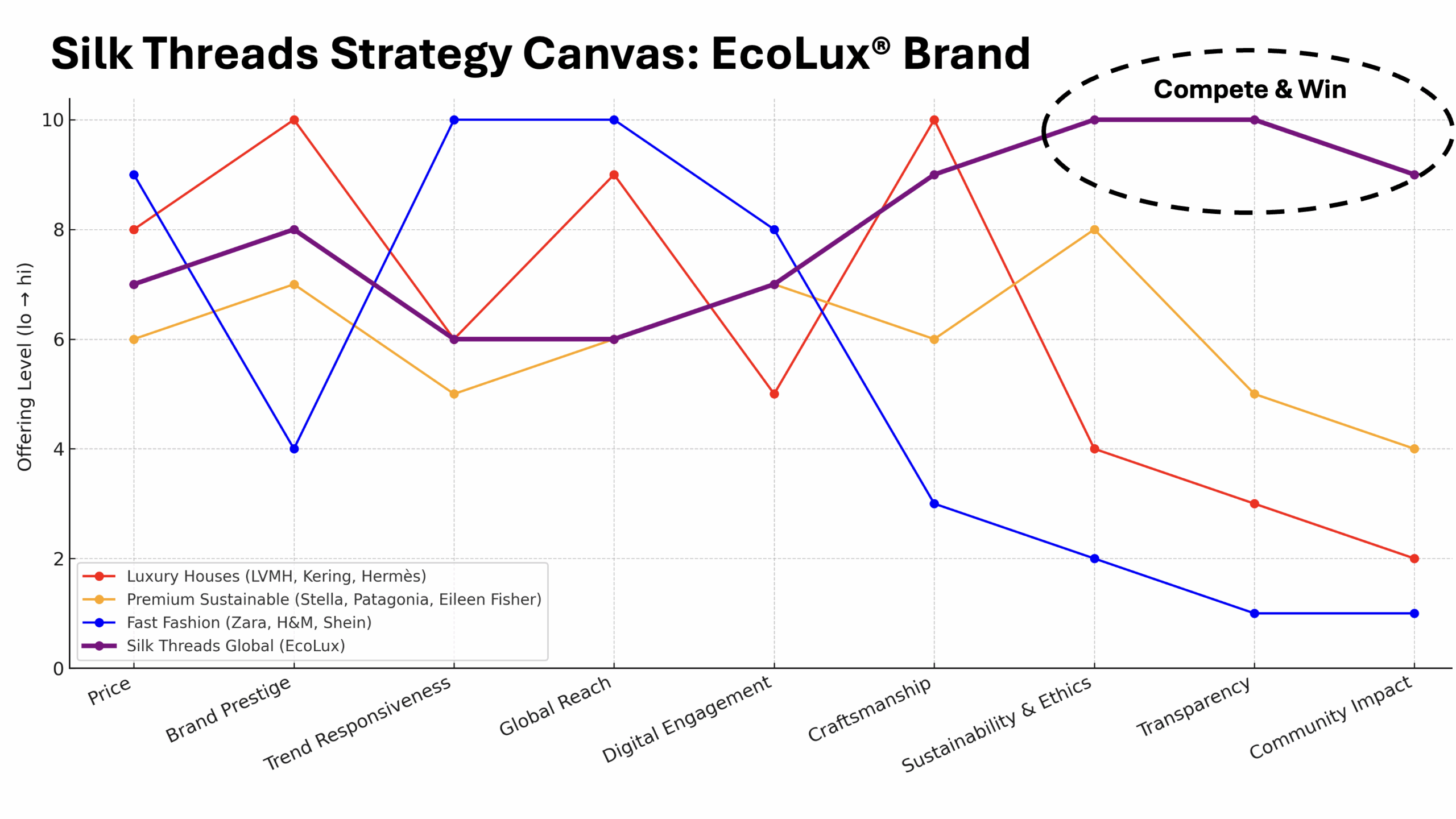
The global fashion industry is intensely competitive, with brands fighting for attention across luxury, premium and fast-fashion segments. At the luxury end, houses like LVMH, Kering and Hermès set the standard in heritage, pricing power and global distribution. At the same time, digital-first, sustainability-forward newcomers are pushing the sector to modernise its storytelling.

In the premium space, labels such as Stella McCartney, Patagonia and Eileen Fisher have built loyal followings by hardwiring environmental and social responsibility into their brands — showing that ethics can be a selling point, not just a cost.

Fast-fashion giants like Zara, H&M and Shein scale by moving at extreme speed: short design-to-retail cycles, wide assortments and global supply networks. But that speed attracts scrutiny around overproduction, waste and labour conditions.

STG sits deliberately between luxury and premium. It wants the design depth and craftsmanship story of European luxury, while still being able to talk credibly about fair wages, safe factories and lower-impact materials. The EcoLux line is the differentiator: a way to show that luxury can be ethical without losing its edge.

STG EcoLux collection branding tile
EcoLux is STG’s proof-of-concept collection: luxury form, lower-impact inputs, and transparent factories.

Silk Threads strategic positioning canvas
Strategy canvas: where STG sits across creativity, sustainability, price, speed and brand narrative.
STG — strategic plan 2030

Investing in future-proof luxury

STG commits to €450 million in investments to reach four 2030 objectives.

Objective 1: Sustainability

Transition 100% of materials to certified sustainable or recycled sources by 2030.

Objective 2: Digital design

Build digital design and virtual-try-on platforms to reduce sampling waste and speed approvals.

Objective 3: Supply chain

Deploy transparency tools (blockchain, real-time labour monitoring) across all production hubs.

Objective 4: Social impact

Scale community programmes that empower workers — especially women — in Bangladesh, Vietnam and Turkey.

Social & environmental factors

Where labour, culture and climate all touch the same garment

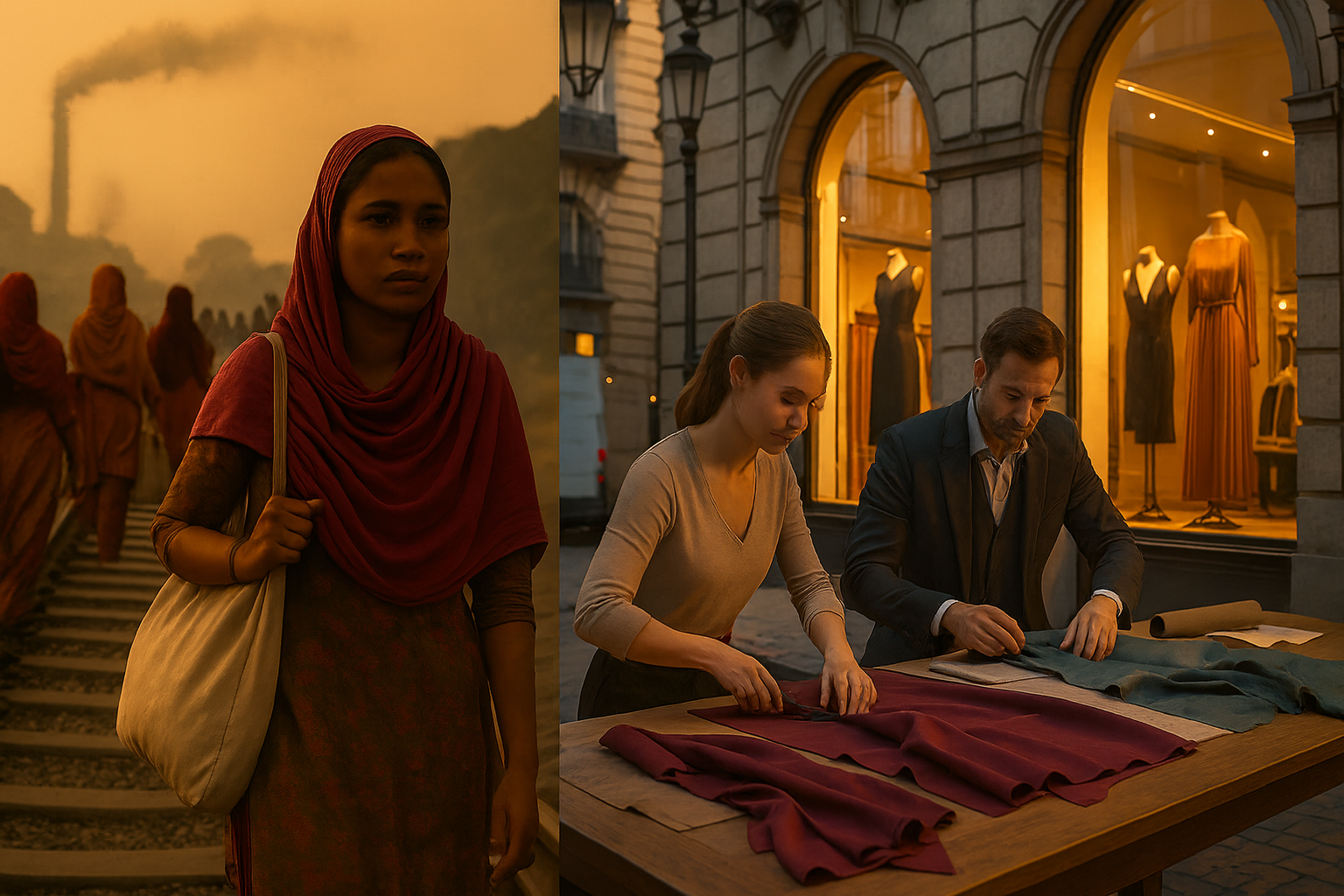
The textile and apparel sector is the beating heart of Bangladesh’s economy, employing over 4.5 million people — most of them women who leave home before sunrise to earn wages that ripple through villages. Garment exports account for roughly 80% of the country’s export earnings and have helped lift families out of poverty. Yet the story has frayed edges: low wages, long hours, crowded living quarters and reliance on fossil-fuel-based materials.

In Italy and France, luxury fashion is tangled up with cultural heritage and artisanal pride, but even these maisons are under pressure to account for their carbon footprints, water use, material sourcing and waste streams.

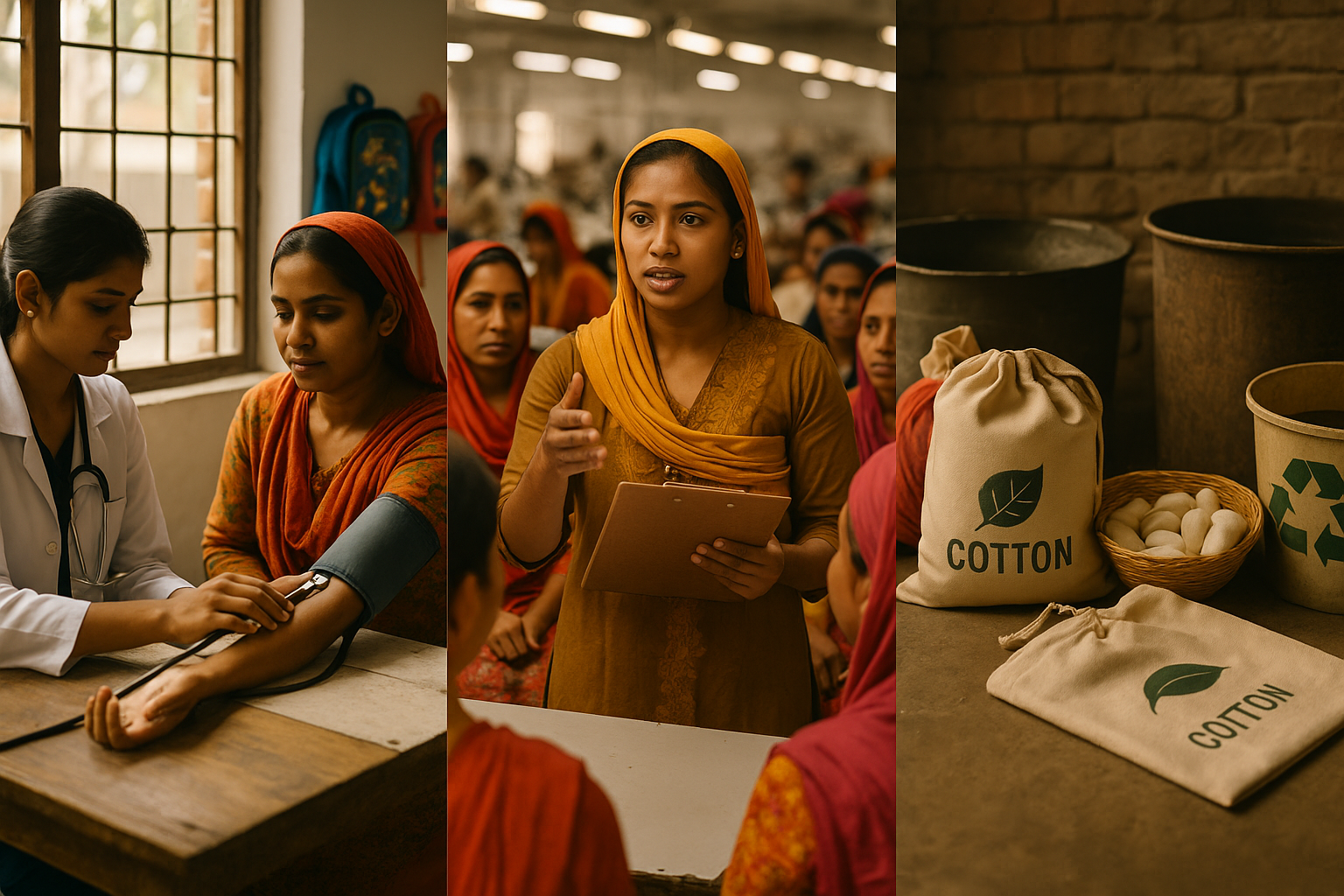
STG’s approach is to say that sustainability is about supply chains and about people. It invests in on-site healthcare, education programmes for workers’ children and micro-finance initiatives that help families stabilise income. With local NGOs, it runs leadership training for female line supervisors, recognising that empowerment usually starts on the factory floor.

EcoLux pushes this further through organic cotton, peace silk and low-impact dyes. These are material choices, but they are also narrative choices — signals to investors, activists and buyers. They introduce cost and volatility, and that is the tension your team will feel in the simulation: doing the right thing usually comes with a price tag.

In this mission, you will see how social, economic and environmental factors can’t be unstitched from one another.

Workers and community programmes connected to STG's supply chain
Bangladesh: millions of women sustain households through garment work.
Sustainability initiatives including healthcare and education for workers’ families
STG supports health, schooling and leadership training — sustainability as people-first.
Operations summary

Design in Europe, produce in South/Southeast Asia, finish in Italy

STG’s operations span three continents. Design & Innovation sits in Milan and Paris, where teams work alongside pattern-makers to translate runway ideas into manufacturable garments.

The primary production facility in Gazipur, Bangladesh employs around 3,200 workers and runs close to 24/7. This is the volume engine that makes EcoLux possible.

Secondary output comes from Da Nang, Vietnam — accessories, smaller runs, and contingency capacity when weather or labour actions disrupt the main plant. In Prato, Italy, a small workshop produces limited editions and keeps craft at the centre of the brand.

Finished garments move via Chittagong Port to European distribution centres. STG prefers sea freight for emissions, but keeps a small air-freight reserve for runway or buyer emergencies.

Milan & Paris design Gazipur — 3,200 workers Da Nang contingency Prato artisanal Sea-first logistics
Operational locations

Where STG designs, builds, and ships from

Each node plays a different role — production, contingency, heritage, or high-visibility launch — and each carries its own risk.

Gazipur, Bangladesh

Primary cut-and-sew facility — ~70% of volume

3,200 workers, 24/7 lines, main site for EcoLux production. Feeds finished garments into export pipeline.

Risks: cyclones / flooding, power stability, continuous H&S compliance.

Chittagong Port, Bangladesh

Primary outbound logistics node

Ships silk and finished garments to European distribution centres; core to the low-emissions, sea-first strategy.

Risks: weather delays, congestion, limited priority windows.

Da Nang, Vietnam

Secondary / contingency facility

Handles accessories and overflow when Gazipur is disrupted. Keeps lead times stable during regional shocks.

Risks: smaller capacity, higher unit costs, exposed to regional trade rules.

Prato, Italy

Artisanal workshop, heritage retention

Limited-edition pieces, couture-level finish, high signalling value for STG’s European identity.

Risks: tiny throughput, high labour cost, but brand-critical.

Paris, France

Design studio & Fashion Week showcase

Final fittings and runway reveal for EcoLux. Point of highest media visibility and activist attention.

Risks: protests, reputational exposure, last-minute logistics needs.

Threats & risks

What can derail EcoLux — and how fast

STG operates across flood-prone geographies, activist-rich markets, and tight shipping corridors. Disruption is normal, not rare.

Environmental threats

Bangladesh’s low-lying geography makes the Gazipur facility vulnerable to flooding and cyclones. Climate change increases the frequency and intensity of these events, threatening workers, inventory and power supply.

Social risks

Even with STG’s welfare investments, the garment sector can be hit by labour-rights allegations. A single incident around child labour or unsafe conditions could undermine years of brand building.

Supply-chain disruptions

Reliance on Chittagong Port concentrates risk. Weather, port congestion, political unrest or export controls can slow or stop shipments — especially during Fashion Week timelines.

Regulatory & geopolitical

Tariff changes, GSP revisions, labour-law shifts or sanctions in Bangladesh, Vietnam or the EU can alter costs and delivery windows overnight.

Security threats

IP theft, industrial espionage or a cyber-attack on supply-chain monitoring could compromise STG’s designs and transparency commitments.

Reputational pressure

Activists, buyers and investors are watching. A leaked factory image or unverified social post can trigger boycotts, lost buyers, or sudden due-diligence requests.

Reality check: These risks stack. A storm that halts Gazipur can coincide with a social-media spike about worker safety. Teams must be ready to address both at once.

Risk matrix showing environmental and supply-chain vulnerabilities for STG
Operational and environmental risk map — Bangladesh sites remain the most exposed.
Threat escalation chart linking activist pressure and reputational damage
Reputational escalation — social-media exposure can outpace operational recovery.
Recent industry scandal

“Stitched Lives” and the return of supply-chain scrutiny

A documentary didn’t name STG — but it touched a subcontractor in STG’s orbit. That was enough to trigger audits, terminations and fresh media attention.

Two years ago, the global documentary “Stitched Lives: The Hidden Seams of Fashion” exposed labour abuses in factories across South Asia. STG’s own facility was not directly implicated. However, one of its tier-three subcontractors in Narayanganj was shown to have violated overtime rules and falsified worker-age documents — exactly the kind of weakness that critics point to when they say luxury brands don’t see what’s happening at the bottom of their supply chains.

STG moved quickly: emergency audits, cutting ties with the subcontractor, and reinforcing worker-empowerment and grievance channels. From a compliance standpoint, the company did what most investors and buyers would expect.

But the story didn’t end. Journalists have continued to track conditions in the region, and new revelations aired this week have pulled STG back into the conversation. That tells your team something vital: reputational capital in this sector is fragile, and distance from the violation (“it was tier three”) isn’t always enough to protect the brand.

Pre-Briefing Checklist

Before you advance to the Mission Briefing please ensure:

  • everyone has read the information above
  • your Facilitator and all Team Members share a good video connection
Scroll to Top